
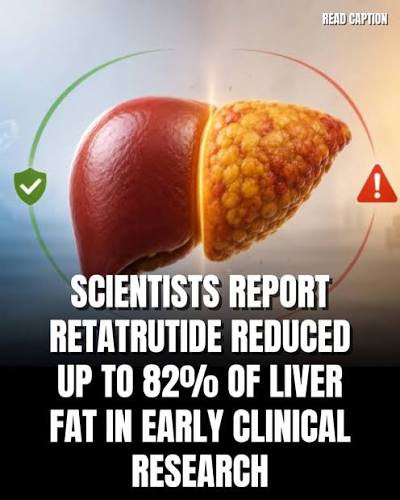
Scientists are urgently searching for effective MASLD (Metabolic Dysfunction-Associated Steatotic Liver Disease) treatments because the “silent epidemic” affects roughly 30% of adults worldwide. Left unchecked, liver fat buildup causes severe insulin resistance and can progress to MASH, permanent scarring (fibrosis), cirrhosis, and liver failure. Historically, doctors had no targeted medications and relied on lifestyle changes, Vitamin E, or off-label diabetes drugs, which yielded limited success. Even Resmetirom, the first FDA-approved MASH medication, typically achieves only a modest 30–38% reduction in liver fat.
Retatrutide represents a major breakthrough because its unique triple-agonist mechanism tackles both systemic obesity and localized liver fat simultaneously. By activating glucagon receptors alongside GLP-1 and GIP, it directly stimulates the liver to burn stored fatty acids while curbing overall calorie intake. Clinical trials demonstrate an unprecedented average liver fat reduction of 82–86%, with up to 93% of patients completely clearing their fatty liver disease (<5% fat) by week 48—far outperforming existing therapies and offering a potential game-changer in liver disease management.
Key Takeaways of Retatrutide in MASLD Treatment
- Mechanism: Retatrutide activates GLP-1, GIP, and glucagon receptors, directly triggering the liver to burn stored fatty acids while curbing appetite.
- Process: Administered via weekly injection, it increases hepatic lipid oxidation and energy expenditure to actively clear intrahepatic fat.
- Outcome: Clinical trials showed an average 82–86% reduction in liver fat, with up to 93% of patients completely resolving fatty liver disease (<5% fat) by week 48.
For years, the fatty liver disease conversation was a footnote in the broader obesity story. If you lost weight, your liver usually improved too that was simply assumed to be collateral benefit, not a targeted effect. Retatrutide is the first drug to seriously challenge that assumption, and after nearly fifteen years covering metabolic health, I don’t say that lightly. The data behind it is genuinely some of the most striking I’ve seen come out of an obesity trial.
Here’s what the science currently supports, what it doesn’t yet prove, and why hepatologists are paying closer attention to this drug than to almost anything else in the incretin pipeline.
A Quick Refresher: What Retatrutide Actually Is
Retatrutide (Eli Lilly’s LY3437943) is a triple hormone receptor agonist. It activates three separate receptors that the body uses to regulate energy: GLP-1, GIP, and glucagon. Semaglutide works on one of these (GLP-1). Tirzepatide works on two (GLP-1 and GIP). Retatrutide is the first to bring all three into a single weekly injection, and that third receptor glucagon is the one that changes the liver conversation.
GLP-1 and GIP act mostly on the brain and gut: they blunt appetite, slow gastric emptying, and improve insulin signaling. Useful for weight loss, but largely indirect when it comes to the liver. Glucagon is different. It’s a hormone the liver listens to directly. When glucagon receptors are activated, hepatocytes are prompted to burn stored triglycerides for fuel, export lipids out of the liver, and modestly raise resting energy expenditure the last of which also seems to help offset the metabolic slowdown that often accompanies rapid weight loss.
That’s the theoretical case for why retatrutide might do something different to the liver than its predecessors. The question, always, is whether trial data backs it up.
Retatrutide in MASLD Treatment: The Trial That Started the Conversation
The data everyone cites comes from a substudy of Eli Lilly’s Phase 2 obesity trial, published by Arun Sanyal and colleagues in Nature Medicine in mid-2024, and it’s still the single most-referenced piece of evidence for Retatrutide in MASLD Treatment. Researchers recruited a subset of participants who had metabolic dysfunction-associated steatotic liver disease (MASLD) — the current clinical term for what used to be called NAFLD, with at least 10% liver fat on MRI, a meaningfully high starting point.
By week 24, participants on the 8 mg and 12 mg doses saw average relative liver fat reductions of roughly 81% and 82%, compared to essentially no change in the placebo group. By week 48, the numbers held and, in some analyses, crept slightly higher, with the 12 mg dose associated with reductions in the 82–86% range depending on which follow-up dataset you’re looking at. Roughly 93% of participants on the top dose brought their liver fat down under the 5% threshold used to define a “normal” liver meaning they no longer met the diagnostic bar for fatty liver disease at all.
For context, older GLP-1 therapies typically produce liver fat reductions in the 30–50% range, largely tracking with how much weight a person loses overall. Retatrutide’s numbers are on another scale entirely, and the fact that the effect showed up so early well before most of the total body weight loss had even occurred is part of why researchers believe there’s a direct hepatic mechanism at work, not just a downstream effect of shedding pounds.
It’s worth noting what that Phase 2a substudy didn’t do: it didn’t use liver biopsies, the gold standard for confirming that inflammation and scarring (not just fat) are actually resolving. MRI-based fat measurement is a well-validated surrogate, but it’s still a surrogate. That distinction matters a lot for what comes next.
Beyond Fat: Signals on Inflammation and Fibrosis
Liver fat reduction alone isn’t the whole story of MASLD. The disease’s real danger is its progression to MASH (metabolic dysfunction-associated steatohepatitis), where fat accumulation triggers chronic inflammation that can scar the liver over time fibrosis that, left unchecked, can progress to cirrhosis or liver cancer.
Follow-up analyses of the retatrutide data have looked at non-invasive fibrosis markers rather than fat alone. The results are more mixed, which is honestly a healthy sign it means the picture isn’t being oversold. Retatrutide has been associated with meaningful reductions in Pro-C3, a blood marker tied to collagen turnover in early fibrosis, but it hasn’t shown the same effect on other commonly used markers like FIB-4 or the ELF score. That’s an important nuance: dramatic fat clearance doesn’t automatically mean dramatic fibrosis reversal, and the two need to be tracked separately in future trials.
Where the Research Stands Right Now
This is the part that’s easy to lose track of if you’re reading enthusiastic headlines: retatrutide is still an investigational drug. It is not approved by the FDA, the EMA, or any other major regulator, and it cannot legally be prescribed outside of a clinical trial.
Eli Lilly has since moved the drug into a large Phase 3 program spanning three families of trials one for obesity, one for type 2 diabetes, and a dedicated liver disease program (often referred to as SYNERGY) built specifically around MASLD and MASH outcomes. That liver-focused program is notably ambitious: it’s designed around thousands of participants and, critically, uses liver biopsy endpoints rather than relying solely on imaging the kind of rigorous histological evidence regulators actually want to see before granting a liver-disease indication.
The first Phase 3 readouts, focused on obesity and diabetes, began reporting in late 2025 and through 2026, generally reinforcing the weight-loss magnitude seen in Phase 2. But the dedicated MASLD/MASH Phase 3 data the trials that would actually confirm whether the liver benefits hold up under biopsy scrutiny in a much larger population are still in progress. Analysts following the program don’t expect a liver-specific regulatory submission until well after the obesity and diabetes indications clear first, which realistically pushes any dedicated MASH approval out toward the end of this decade.
In short: the Phase 2 numbers are remarkable, and they’ve been enough to make retatrutide the drug hepatologists talk about first when this topic comes up. But “remarkable Phase 2 data” and “proven treatment” are two different things, and the field is still waiting on the trial that closes that gap.
How It Stacks Up Against What’s Already Out There
It’s worth putting retatrutide in context alongside the drugs already reshaping MASLD care. Resmetirom, a thyroid hormone receptor-beta agonist, already has Phase 3 data and is FDA-approved specifically for MASH with fibrosis it’s the current benchmark, not a hypothetical competitor. Semaglutide’s dedicated liver trial (ESSENCE) and tirzepatide’s liver data are also further along the regulatory pipeline than retatrutide’s liver-specific program, even though retatrutide’s raw fat-reduction numbers look more dramatic on paper.
That’s a useful reminder that percentage reductions in liver fat, while genuinely exciting, aren’t the finish line. Regulatory approval for a liver indication hinges on biopsy-confirmed resolution of steatohepatitis without worsening fibrosis a higher, slower bar that takes years of trial data to clear.
The Practical Caveats Worth Knowing
A few things worth keeping in mind if you’re following this closely, especially given how much hype circulates around triple agonists online:
The liver data comes from a relatively small group. The original substudy included fewer than 100 participants split across five arms, and by week 48 the MRI subgroups were down to single digits in some arms. Impressive numbers, small sample. Larger Phase 3 data is what will tell us if the effect holds at scale.
Side effects are real and dose-dependent. Nausea, diarrhea, and constipation were common in the higher-dose groups, consistent with what’s seen across the incretin drug class. Rapid weight loss from any of these agents also carries some risk of gallbladder issues.
It is not currently available for prescription. Anything sold outside a monitored clinical trial isn’t the studied, regulated product, and shouldn’t be treated as equivalent to it.
The Bigger Picture
What makes retatrutide’s liver data genuinely significant isn’t just the size of the numbers it’s what they suggest about drug design going forward. MASLD affects an enormous share of the global population, largely silently, and for a long time the only real lever available was weight loss itself. A drug that appears to act on the liver somewhat independently of total weight loss, through a distinct hormonal pathway, opens up a different way of thinking about treatment potentially benefiting patients whose liver disease is out of proportion to their body weight, or who need faster liver-specific improvement than gradual weight loss alone would provide.
Whether that promise survives the transition from a 98-person Phase 2a substudy to a multi-thousand-person, biopsy-confirmed Phase 3 trial is the real test still ahead. For now, retatrutide remains one of the most closely watched compounds in metabolic medicine earned, cautious optimism, rather than a settled answer.
This article is for informational purposes and reflects publicly available clinical trial data as of mid-2026. It is not medical advice. Retatrutide is investigational and not currently approved for any indication; anyone with concerns about liver health should speak with a physician or hepatologist.
